CC
Dr. Christian Czauderna Guest post
System Thinker - Solutions for all
On 9 September, Mercedes-Benz Trucks handed over the first 27 eActros 600 to Amazon in Germany. By the end of the year there are to be more than 50, part of an order of over 200 vehicles for Germany and the United Kingdom – the largest order of heavy electric trucks Amazon has ever placed. They will run on what is called the middle mile, between fulfilment centres and urban delivery stations. The company puts its investment in electrifying its European transport network at more than a billion euros, over 400 million of that in Germany.
I start with Amazon because the example shows three things at once: that the vehicles exist, that their use pays off when the operating profile fits – and that the real bottleneck lies elsewhere.
### What the manufacturers deliver
Three years ago the electric tractor unit was a promise. This week several production models stand side by side in Hanover, and the ranges have crossed a threshold.
The eActros 600 covers around 500 kilometres at 40 tonnes gross combination weight, with 621 kilowatt hours in three LFP battery packs. MAN is showing the new eTGX with up to 644 kilowatt hours and up to 720 kilometres under favourable conditions; the standard version has 552 kilowatt hours and 660 kilometres. Volvo quotes up to 700 kilometres for the FH Aero Electric with 780 kilowatt hours, orderable since the summer. Scania, DAF and Renault Trucks have their own model lines. And Tesla has for the first time given figures for the European version of the Semi: around 550 kilometres at 40 tonnes and consumption of roughly one kilowatt hour per kilometre – a remarkable figure, if it holds up in winter, on gradients and at motorway speed. Tesla still names no price.
These manufacturer figures apply to good conditions. In practice, fully loaded, one should reckon with 70 to 80 per cent of them. But even then the message is clear: for domestic long haul with daily distances up to 500 kilometres the battery suffices, and with one charging stop during the mandatory 45-minute break it stretches to 800 to 1,000 kilometres a day.
Hydrogen no longer plays a role in this segment. In 2025 fuel-cell trucks reached a market share of 0.1 per cent in Europe.
### How far the market has come
The numbers are, frankly, still small. In the EU in the first half of 2026, some 3,400 of 146,000 heavy trucks over twelve tonnes sold were zero-emission – 2.3 per cent, up from 1.4 per cent a year earlier. Diesel holds 92 per cent. Germany stood at 4.6 per cent in the second quarter, above the EU average; the Netherlands reached over 18 per cent in 2025, Norway almost 17.
Globally the picture is different: the IEA counts more than 400,000 electric trucks sold in 2025, a global share of nine per cent – driven by China. Europe is not the pioneer here; Europe is catching up.
### What a tractor unit costs
No manufacturer publishes list prices; everything is negotiated. As a rule of thumb, reckon with one and a half to two times the price of a diesel tractor unit; for the eActros 600 a figure of around 300,000 euros is circulating, while a comparable diesel costs 100,000 to 120,000. That is the investment hurdle, and it is real.
Operating costs turn the picture around. Mercedes-Benz Trucks itself reckons with around 40 euros in fuel per 100 kilometres for the diesel tractor unit against just under 24 euros in electricity for the eActros 600 – at depot charging on a favourable tariff, not at the public charger. Add lower maintenance, because engine, gearbox and exhaust after-treatment disappear.
The largest single item, however, is the road toll. Battery-electric trucks are fully exempt until 30 June 2031; a Euro 6 diesel pays around 35 cents per kilometre in 2026, so roughly 35,000 euros at 100,000 kilometres a year. The greenhouse gas quota adds up to 5,800 euros annually for heavy electric trucks. Over five to seven years, according to common calculations, cost parity arrives at around 60,000 to 70,000 kilometres of annual mileage – below that diesel stays cheaper, above it the balance tips.
Two items are missing from this calculation, and both are uncomfortable. The residual value of an electric truck after seven years is unknown, because none is that old yet. And the charging infrastructure at the depot costs between 100,000 and 500,000 euros depending on the grid connection – a sum that spreads across a fleet of ten vehicles but blows up the calculation for a single one.
### Why infrastructure decides
This is the core. Amazon can electrify because Amazon has its own depots, runs scheduled line-haul services and, by its own account, is installing hundreds of charging points at its European sites. That is the profile in which electric trucks work today: overnight depot charging, fixed routes, return to base.
The mid-sized haulier with changing tours across Europe does not have that profile. He needs the public network – and that is only just coming into being.
The state of play: the first public megawatt charging point in Germany went into operation in September 2025 on the A2 motorway, at 1.2 megawatts. The technical specification for the Megawatt Charging System was published only in February 2026; it allows up to 3.75 megawatts. Milence, the joint venture of Daimler Truck, Traton and Volvo, aims to operate 50 charging parks in ten countries by year end, 18 of them in Germany, and to reach 90 parks with 284 megawatt charging points by 2028. The federal government has had a programme of 1.6 billion euros approved: up to 1,410 charging points at more than 120 unserviced motorway rest areas, the majority of them megawatt chargers. The first 836 points have been awarded; E.ON and Tank & Rast are building 195 of them at 24 sites.
That sounds like a lot. It is the beginning. And the real hurdle appears in none of these announcements: for the rest areas, grid connections have to be realised with more than 90 distribution network operators. A charging park with eight megawatt points needs a connection of the kind a mid-sized industrial company has. Permits, land, transformer station, cabling – in Germany that takes two to four years. Milence has therefore integrated a stationary battery into its charging park in Kassel to make do with a weaker grid connection. That is a clever workaround, but it is a workaround.
I see the same pattern here as in the chemical industry: the technology is further along than the grid that is supposed to supply it. The vehicles come from Wörth, Munich and Gothenburg – the transformer stations come from permitting procedures.
### Where the trucks already are
There is a charging infrastructure that appears in no funding programme, because it already exists: the industrial sites.
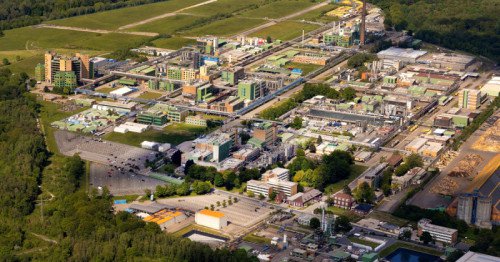
A large chemical park on the Rhine handles more than 1,000 trucks a day. They run fixed relations – to the port, to the customer, to the neighbouring site –, they wait at the gate, they are weighed, loaded and unloaded, and they come back. That is exactly the profile in which Amazon runs electric today. Except that a chemical park has something neither Amazon nor the motorway rest area has: a grid connection designed for energy-intensive production. The transformer station that a motorway charging park fights three years for has stood there for decades.
That shifts the arithmetic. The federal government is investing 1.6 billion euros to create grid connections at rest areas that already exist at industrial sites. A chemical park that equips its gates with charging points replaces part of that network – for the trucks that call there anyway, and in principle for those merely passing by. Twenty megawatt charging points at a site with a thousand truck movements a day would be more than the first Milence corridor between Paris and Berlin has today.
That it has hardly happened so far has reasons, none of them technical. The site operator is not a charging provider. The hauliers are many, and none of them is large enough to invest alone. And the grid connection belongs to production, not to the vehicles at the gate. A coordination problem in which any party could start and none has the incentive to go first.
I am not writing this purely as an observer. At the site where I work, precisely this start has been made: site operator and site logistics provider are tackling the subject together. Whether it becomes a model for other industrial sites will be decided over the next two years – and by whether hauliers and shippers come along. Anyone interested will find me.
### What this means for the industry
The EU is tightening CO2 limits for heavy-duty vehicles to minus 45 per cent by 2030 and minus 90 per cent by 2040 against 2019. The manufacturers have responded, visibly so in Hanover. The toll exemption until 2031 gives fleet operators five years of planning certainty – what the equation looks like after that is open.
For logistics companies this means: anyone running depot-based services with high mileage today can make the electric case and should. Anyone dependent on the public network has to match their core routes against the planned sites and will probably run a mixed fleet for another two to three years. And anyone who defers the switch to 2030 will find that grid connections and charging parks are even scarcer then than now.
What remains open for me is whether the federal government's 1.6 billion euros will be enough if the ramp-up actually arrives – and who builds the grid connections when the distribution network operators are already at capacity with heat pumps, wallboxes and industrial electrification.
My question to you: do you see the bottleneck in the vehicle, in the price or in the grid – and what would have to happen first for mid-sized companies to make the switch as well?
## Sources
- Amazon / Mercedes-Benz Trucks, press release of 9 September 2026: handover of the first 27 eActros 600
https://www.presseportal.de/pm/118379/6348514
- electrive: Amazon takes over first eActros 600 in Germany (9 September 2026)
https://www.electrive.net/2026/09/09/amazon-eactros-600-i…
- trans.info: IAA Transportation 2026 – trends, MAN eTGX, Volvo FH Aero Electric (September 2026)
https://trans.info/de/iaa-transportation-2026-lkw-trends-…
- ecomento / ICCT: zero-emission trucks in the EU in the first half of 2026 (7 August 2026)
https://ecomento.de/2026/08/07/mehr-emissionsfreie-lkw-un…
- electrive: ACEA figures 2025, market shares by country (29 January 2026)
https://www.electrive.net/2026/01/29/acea-bilanz-2025-e-l…
- E-LKW24: TCO comparison electric vs. diesel, fuel, toll and infrastructure costs (July 2026)
https://www.e-lkw24.de/wissen/tco-vergleich-e-lkw-diesel/
- emobicon: e-truck TCO calculator, toll rates and GHG quota (August 2026)
https://emobicon.de/tco-rechner-e-lkw/
- electrive: "Deutschlandnetz" for trucks – operators awarded for 124 rest areas (1 July 2026)
https://www.electrive.net/2026/07/01/deutschlandnetz-fuer…
- ingenieur.de: 1.6 billion euros for a truck charging network (December 2025)
https://www.ingenieur.de/technik/fachbereiche/verkehr/deu…
- electrive: Milence charging corridor Paris–Berlin, expansion targets to 2028 (23 April 2026)
https://www.electrive.net/2026/04/23/e-lkw-quartett-erpro…
- Fraunhofer ISI: first public megawatt charging point on the A2 (October 2025)
https://www.isi.fraunhofer.de/en/presse/2025/presseinfo-1…
- Cleanthinking / IEA: electric mobility 2026, global truck sales 2025 (September 2026)
https://www.cleanthinking.de/elektromobilitaet-2026-globa…
Image: concept study, AI-generated.

C
System Thinker for a Sustainable Industry Transition in EU
**Market potential, societal significance and state of development – Germany and the EU compared with the rest of the world**
*As of September 2026*
---
## Key Takeaways
- **The problem is smaller than its reputation – and still unsolved.** Around 85–90% of a wind turbine's mass (tower, foundation, nacelle structure, generator, cabling) can be recovered using established processes. The real challenge is the rotor blades made of fibre-reinforced thermoset composites – plus nacelle covers and, further ahead, the rare-earth magnets in the generators.
- **The wave is arriving now.** Germany operates around 29,000 turbines; about half have been running for at least 15 years, roughly 9,700 for more than 20 years. The German Environment Agency (UBA) expects up to 20,000 tonnes of blade material per year this decade and up to 50,000 tonnes per year in the 2030s – the federal government puts peak years at up to 75,000 tonnes.
- **Europe: from 20,000 to 55,000 tonnes a year.** WindEurope expects blade waste to nearly triple between 2025 and 2030, driven mainly by Germany and Spain. Globally, some 43 million tonnes of cumulative blade waste are expected by 2050 – 40% of it in China, 25% in Europe, 16% in the United States.
- **The market is small but steep.** MarketsandMarkets valued pure blade recycling at USD 68 million in 2024 and projects USD 371 million by 2029 (+40% p.a.). The overall market for decommissioning, logistics, metal recovery and component trading is many times larger.
- **Europe leads on rules and technology, China on volumes and pace, the US lags behind.** Since 1 January 2026 the European wind industry has operated under a self-imposed landfill ban; since 30 June 2026 the EU requires new rotor blades in public procurement to be at least 70% recyclable. China has mandated a closed take-back system by 2030 and is already building fully recyclable turbines. In the US, most blades still go to landfill.
- **The bottleneck is economics, not technology.** Recycling processes work, but cost several times more than landfilling – and there is not yet reliable demand for the recyclates.
---
## 1. Starting Point: The First Build-Out Wave Reaches End of Life
Wind turbines are designed for 20 to 25 years of operation, with lifetime-extension assessments up to 30. The turbines that made up the first major build-out wave in the late 1990s and early 2000s are reaching the end of their technical and economic life right now. This is amplified by **repowering**: old sites are rebuilt with fewer but far more powerful turbines – economically sensible, but an additional driver of early decommissioning.
### Germany: Europe's Largest Ageing Fleet
At the end of 2025, 29,226 onshore wind turbines were operating in Germany. Around half of them have been in service for at least 15 years, roughly 9,700 for more than 20 years. Broken down to rotor blades: of the roughly 88,000 blades in the German onshore fleet, more than 42,000 hang on turbines that are already older than 20 years or will reach that threshold by 2030.
The waste stream has long since begun. Since 2020, more than 2,300 onshore decommissionings have been registered, 627 in 2024 alone; a further 210 turbines with 326 MW were added in the first half of 2025. At the same time, 35% of newly installed capacity in the first half of 2025 came from repowering projects.
Several estimates exist for future volumes, and they agree in order of magnitude:
| Source | Forecast for Germany |
|---|---|
| German Environment Agency, UBA (rotor blade study, 2022) | up to 20,000 t of blade material/year in the 2020s, up to 50,000 t/year in the 2030s |
| Federal government / Bundestag Research Services (2026) | 3,000–75,000 t of GFRP and up to 3,000 t of CFRP per year, rising in the early 2030s; 326,000–430,000 t of glass-fibre blades cumulatively by 2040 |
| Office of Technology Assessment at the Bundestag (TAB, January 2026) | a "strongly growing volume" against insufficient treatment capacity |
Notably, the newer estimates are lower than earlier studies – because lifetime extension, blade repair and the sale of used turbines abroad stretch the waste volumes over time. That does nothing to change the TAB's finding that Germany currently has neither sufficient nor technically mature capacity to treat these volumes to a high standard.
### Europe: 80 GW Reach Theoretical End of Life by 2030
Of roughly 290 GW of wind capacity in Europe, about 80 GW will reach the end of their theoretical operating life by 2030. Many turbines will keep running, but a growing share is being dismantled. WindEurope estimates annual blade waste at around 20,000 t in 2025 and about 55,000 t in 2030; for the coming years the association projects around 14,000 blades to be dismantled, equivalent to 40,000–60,000 t of material.
### World: China Becomes the Largest Waste Market
The most-cited global forecast comes from the University of Cambridge (Liu & Barlow): by 2050, some 43 million tonnes of blade waste will accumulate worldwide – about 40% in China, 25% in Europe, 16% in the US and 19% in the rest of the world. Estimates for China alone range from 7.7 to 23.1 million tonnes by 2050; around 280 GW of wind capacity there is expected to retire by 2040. For the US, the National Renewable Energy Laboratory (NREL) projects 1.5 million tonnes of cumulative blade mass by 2040 and 2.2 million tonnes by 2050 – across more than 70,000 onshore turbines, some 7,500 of which are already 20 years or older.
---
## 2. What a Wind Turbine Is Made Of – and Why the Blade Is the Problem
A modern turbine such as the Vestas V162 (6.2 MW) consists of around 88% steel, iron and other metals and about 10% composites and polymers; the remainder is electronics, operating fluids and lubricants. The US Department of Energy puts the commercially recyclable share of mass at 85–90%.
| Component | Main materials | Recovery today |
|---|---|---|
| Tower | Structural steel (100–200 t per turbine), concrete in hybrid towers | Scrap market – established, positive revenue |
| Foundation | Reinforced concrete (several hundred to over 1,000 m³) | Recycled concrete, rebar – established but costly to remove |
| Nacelle and drivetrain | Steel, cast iron (bedplate 3–5 t/MW), copper, aluminium, gearbox, electronics, oils, SF6 in switchgear | Metal recycling, refurbishment of gearboxes/generators; hazardous materials disposed of separately |
| Generator | Copper, electrical steel; in direct-drive designs NdFeB permanent magnets (on average c. 600 kg per turbine, large offshore direct-drive units up to c. 4 t) | Copper established; magnet recycling at pilot stage, no commercial capacity in the US |
| Rotor blades | > 85 wt% glass-/carbon-fibre-reinforced thermoset, plus balsa, PET/PVC foam, adhesives, gelcoat/PU coatings, metal root inserts, lightning protection | Cement co-processing and shredding dominate; pyrolysis/solvolysis being scaled up |
| Nacelle cover, spinner | GFRP (300–3,500 kg/MW) | as rotor blades |
### Anatomy of a Rotor Blade
A typical blade from a turn-of-the-millennium turbine (37 m, around 5.6 t) consists of about 58% glass fibre, 37% polymers (polyester, vinyl ester, PVC) and 5% balsa wood. Newer and longer blades rely on epoxy resins and – at lengths above roughly 45 m – on carbon fibre in the spar caps, which saves around 20% in weight. Sandwich cores are balsa or, increasingly, PET foam. The fibres are embedded in cured resin; unlike steel or thermoplastics, this composite cannot be melted down. That is precisely the recycling problem.
### The Second Front: Rare Earths
Direct-drive generators contain up to ten times more rare-earth elements (neodymium, praseodymium, dysprosium) than geared designs. Since Europe depends almost entirely on imports, magnet recycling from wind turbines is relevant to the EU Critical Raw Materials Act – although volumes will remain modest until the late 2030s, because direct-drive turbines were only installed in large numbers from the 2010s onwards.
---
## 3. Market Potential
### The Core Business: Blade Recycling
MarketsandMarkets values the global blade recycling market at USD 68 million (2024) and expects USD 371 million by 2029 – annual growth of just over 40%. The absolute size is still modest; the growth rate reflects the low base and the steep rise in decommissioning volumes. The market is at the start of its "hockey stick" phase: the volumes are certain to come, the recovery routes are not yet.
### The Wider Field: Decommissioning, Logistics, Metals, Components
The real business is broader than blade recycling:
- **Decommissioning and dismantling** – legally mandatory in Germany (decommissioning obligation under Section 35 of the Federal Building Code, backed by a financial guarantee), soon standardised by DIN 4866 "Demolition and dismantling of wind turbines" (draft since September 2025).
- **Logistics** – blades of 40 to over 100 m must be cut on site with special saws under dust protection and moved by oversized transport; regional processing sites become a locational factor.
- **Metal recovery** – tower steel, copper and castings generate positive revenue and fund part of the decommissioning.
- **Second-life components** – used gearboxes, generators and entire turbines find buyers in Eastern Europe, Latin America and Asia.
- **Recyclate marketing** – glass fibre for construction and automotive applications, carbon fibre for nonwovens and injection moulding, pyrolysis oil as a chemical feedstock, composite panels for façades and doors.
### The Cost Logic
According to US estimates, recycling costs USD 1,000–2,000 per tonne, while landfilling there costs only USD 60–150. As long as landfilling is permitted, it wins. In Europe, where landfill bans apply or are taking hold, recycling instead competes with energy recovery in cement kilns. That route is established and can handle large volumes, but yields no high-value recyclate. Fraunhofer researchers consider the processes ready for industrial deployment – the biggest obstacle, they say, is the lack of demand for recycled materials, which deters companies from investing; a recycling quota could help.
Capital is flowing nonetheless: Acciona is building the Waste2Fiber plant with EUR 5.3 million in Spanish PERTE funding (over 100 jobs), Continuum has raised venture capital for a network of six European factories, Stena Recycling and the Swedish Energy Agency are financing the industrial test bed in Halmstad, and Iberdrola and FCC operate EnergyLoop, the Iberian Peninsula's first dedicated blade recycling facility (10,000 t/year).
---
## 4. The Difficulties
1. **The material.** Thermosets are chemically cross-linked and cannot be melted. Fibre and matrix must be separated thermally or chemically – at temperatures of 400–700 °C (pyrolysis) or with solvents under pressure (solvolysis).
2. **Heterogeneity and missing documentation.** Older blades were not designed for disposal. Which resin systems, whether carbon fibre, which core materials were used is often undocumented – and the quality of the recyclate fractions varies accordingly. Recyclers such as Eurecum stress that full recovery is only possible with homogeneous GFRP.
3. **Carbon fibre.** GFRP is considered the recycling problem of the past, CFRP the problem of the future. Carbon fibres do not burn completely in waste incinerators, can damage plants and disrupt flue-gas cleaning; they are unwanted in cement kilns. Significant volumes will arrive from decommissioning in the 2030s, and a clear waste classification for CFRP is still missing.
4. **Size and logistics.** A single blade weighs 4 to over 30 t; on-site cutting generates fibre dust and requires occupational safety measures, transport requires special permits.
5. **Costs and a missing recyclate market.** Recyclates are worth less than virgin material and the processes are energy-intensive. Without landfill bans, quotas or offtake agreements, high-value recycling only pays in niches.
6. **Regulatory patchwork.** Waste codes do not distinguish turbine components; blade waste is often mixed with construction waste and hard to trace. WindEurope therefore calls for dedicated waste codes for rotor blades and permanent magnets.
7. **The time gap.** Recyclable blades have been entering service since 2022 – their decommissioning begins in the 2040s. The next 15 years of decommissioning will be dominated by legacy blades that no new design can help. Between the material already in place and the available processes lies a gap of roughly a decade.
---
## 5. Processes: What Works Today – and What Is Still in the Lab
| Process | Principle | Output | Maturity | Examples |
|---|---|---|---|---|
| Lifetime extension / second-hand | Extended operation, sale of whole turbines | Waste deferred | established | lifetime-extension assessments, used-turbine trade |
| Repurposing | Blade segments as building elements | bridges, noise barriers, playgrounds, furniture | niche, visible | BladeBridge (IE), Blade Made (NL), Blattwerk (DE), Vattenfall car park (SE) |
| Mechanical recycling | Shredding, sorting, pressing | fillers, composite panels | industrial (low value) | Continuum (DK), REGEN Fiber (US), Eurecum (DE) |
| Cement co-processing | Resin supplies energy, glass fibre/minerals replace raw materials in clinker | cement, no fibre recovery | industrial, large-volume | neocomp/Holcim Lägerdorf (DE), Veolia/GE (US), Geocycle |
| Pyrolysis | Thermal decomposition of the matrix without oxygen | fibres (partly weakened), oil, gas | first industrial plants | Carbon Rivers (US), Makeen Energy (DK), Waste2Fiber/Acciona (ES), Fraunhofer Re SORT (DE) |
| Solvolysis / chemical recycling | Chemical breakdown of the resin | virgin-grade fibres, resin building blocks | industrial test phase | Vestas/Stena/Olin (CETEC), Fraunhofer IGCV, EoLO-HUBs |
| Design for recycling | Cleavable or thermoplastic resins | fully separable blade | first series projects | Siemens Gamesa RecyclableBlade, ZEBRA/Elium, Swancor EzCiclo |
**Cement co-processing** is today's standard route in Germany and Europe. At neocomp in Bremen – a joint venture of Nehlsen and neowa – blades are shredded, mixed with rejects from the paper industry and delivered to the Holcim plant in Lägerdorf as substitute fuel and raw material; the facility can handle up to 30,000 t of GFRP per year. According to WindEurope, every tonne recovered this way saves up to one tonne of CO₂ compared with waste incineration. The catch: the fibres do not return as a material – in terms of the waste hierarchy this is recovery, not recycling.
**Pyrolysis** is the route to fibre recovery closest to industrial scale. Carbon Rivers (Knoxville, Tennessee), funded by the US Department of Energy, reports recovering glass fibre at 99.9% purity and is scaling to over 50,000 t of annual capacity. Acciona's Waste2Fiber in Lumbier (Navarre) uses low-temperature pyrolysis that largely preserves fibre properties; the plant is planned at 6,000 to 10,000 t/year and due to start in 2026. In Germany, the Fraunhofer project Re SORT (IFAM, IWES, WKI; running until 2026) is investigating batch and microwave pyrolysis specifically for thick-walled blade laminates.
**Chemical recycling** is the technological breakthrough of recent years. The Danish CETEC project (Vestas, Olin, Aarhus University, Danish Technological Institute) developed a process that breaks epoxy resin down into its constituents using widely available chemicals – applicable to blades already installed, without redesign. In May 2026, Stena Recycling and Vestas reported the move from laboratory to an industrial test bed in Halmstad, where epoxy, carbon and glass fibre, PET foam and aluminium are separated under real operating conditions; Stena expects a market-ready model "within a few years". The EU project EoLO-HUBs, with 20 partners including Fraunhofer IWES, aims to set up demonstration plants in Spain and Germany by the end of 2026 covering the entire chain from blade to new fibre.
**Design for recycling** shifts the focus from the old blade to the new build:
- **Siemens Gamesa** launched the RecyclableBlade in 2021 – a resin with cleavable bonds that can be separated again from fibres, wood and foam in a mildly acidic solution. After its debut in RWE's Kaskasi offshore wind farm (2022), the 1.4 GW Sofia project is being fitted with 150 of these blades on 50 of its 100 turbines; the manufacturer aims to offer fully recyclable turbines by 2040.
- **ZEBRA** (IRT Jules Verne, Arkema, LM Wind Power/GE Vernova, Owens Corning, Suez, Engie) manufactured a 62 m blade from the thermoplastic resin Elium in 2022 and demonstrated the closed loop in 2024: resin and glass fabric were recovered and reused. When series production will be reached remains open.
- **Swancor** (Taiwan) supplies EzCiclo, a recyclable thermoset resin already going into series production in China: Mingyang built the first recyclable blade by a Chinese OEM in 2023 (75 m), Times New Material a 110 m blade, and in 2025 Goldwind and Sinoma Blade erected China's first fully recyclable turbine in Jilin.
- **Nordex** has announced fully recyclable blades for 2032; **Enercon** targets 2030.
---
## 6. Societal Significance
**Credibility of the energy transition.** Images of rotor blades in landfills are the most effective argument of wind-power opponents. Anyone who wants to maintain public acceptance for expansion must solve the end of the life cycle as cleanly as its beginning. The industry's self-imposed landfill ban is therefore also a matter of communication policy.
**Resource and climate protection.** Every tonne of glass or carbon fibre recovered replaces energy-intensive virgin material; carbon-fibre production is concentrated in a handful of sites worldwide (global demand in 2024: around 126,500 t). Even energy recovery in cement kilns saves CO₂ compared with incineration or landfill.
**Raw-material sovereignty.** Copper, aluminium and above all the rare earths in permanent magnets are strategic resources. NREL estimates that wind turbines could occupy up to 30% of US recycling capacity for copper and aluminium by 2040. In Europe, the Critical Raw Materials Act addresses precisely this recovery.
**Jobs and regional value creation.** Decommissioning, cutting and processing take place where the turbines stand – in northern Germany, Navarre, Jutland, Iowa. Waste2Fiber creates over 100 jobs, Continuum plans 60–65 per factory, and recycling sites generate 15–25 direct jobs plus logistics. For port and industrial locations, blade recycling is a new business field at the interface of energy, chemicals and waste management.
**Industrial policy.** The EU Clean Industrial Deal aims to make Europe the world leader in the circular economy by 2030. The rotor blade is a test case: if a closed loop for composites succeeds here, the processes can be transferred to boats, aircraft, vehicles and building components – blade waste accounts for less than 5% of Europe's total thermoset composite waste.
---
## 7. State of Play in Germany
**Regulation.** Germany is – alongside Austria, Finland and the Netherlands – one of the few countries where rotor blades effectively cannot be landfilled. The decommissioning obligation with a financial guarantee is anchored in the Federal Building Code. What is missing are binding recovery standards: in 2022 the German Environment Agency published its 582-page rotor blade study, a complete concept for maintenance, dismantling, pre-shredding and processing, and proposed supplementary legal requirements. DIN 4866 will for the first time standardise responsibilities and procedures in decommissioning; its binding publication was announced for the second quarter of 2026.
**Industry.** The established recovery routes are mechanical-thermal: neocomp (Bremen) with the cement route via Holcim Lägerdorf, Eurecum (Eisleben) with cutting, shredding and marketing of GFRP fractions as substitute fuel or granulate, plus decommissioning specialists such as neowa with mobile cutting equipment. There are no industrial-scale fibre-recovery plants yet; Continuum has a German factory in its six-site plan, and EoLO-HUBs intends to build a demonstration plant.
**Research.** Germany is strong in process development: Fraunhofer IFAM, IWES and WKI (Re SORT, pyrolysis), Fraunhofer IGCV (solvolysis with subcritical water), Fraunhofer EMI (a mechanical peeling process for carbon fibre, funded by the Federal Ministry for Economic Affairs), plus Fraunhofer IWES as a partner in EoLO-HUBs.
**Assessment.** Germany has Europe's largest ageing fleet, a landfill ban and the relevant research landscape – but no industrialisation of high-value processes. The Bundestag describes a gap between expansion policy and circular economy: technical processes exist, but many are still on the way to economically viable large-scale application. The risk is that the volumes of the 2030s continue to end up predominantly in cement kilns.
---
## 8. State of Play in the EU
**Voluntary commitment and law.** In 2021 WindEurope called for a Europe-wide landfill ban from 2025 and committed the industry to reuse, recycle or recover 100% of decommissioned blades – and not to dispose of European blades outside Europe. Since 1 January 2026 the self-imposed landfill ban has been in force; the association is pressing for it to be enshrined in EU law.
**Net-Zero Industry Act.** Since 30 June 2026, Implementing Regulation (EU) 2026/718 requires, for certain public procurements of onshore and offshore wind turbines, that the rotor blades achieve a recyclability of at least 70% – implementable as a technical specification or a contract performance condition. The requirement describes the design-level separability of new blades, does not apply retroactively and does not cover the legacy blades that will dominate decommissioning in the coming years.
**Circular Economy Act.** The Commission's Circular Economy Act, announced for 2026, is intended to harmonise waste management. The industry is calling for dedicated waste codes for rotor blades and permanent magnets so that volumes become traceable and treatment obligations enforceable.
**Plants and projects.** Europe has the densest landscape of processes and consortia: EnergyLoop (Iberdrola/FCC Ámbito, Navarre, 10,000 t/year) and Waste2Fiber (Acciona/RenerCycle, Lumbier) in Spain, the Stena/Vestas test bed in Halmstad, Makeen Energy (pyrolysis, Randers) and the DecomBlades consortium in Denmark, Continuum's factory plan for Denmark, the UK, France, Germany, Spain and Turkey (36,000 t/year each, timeline delayed), and the Horizon projects ZEBRA, REFRESH, BLADES2BUILD and EoLO-HUBs. Vattenfall aims to recycle 100% of its blades by 2030.
**Assessment.** The EU leads on rule-setting, manufacturer obligations and chemical recycling. What remains open is cost competitiveness, inconsistent waste classification and the ratio of 55,000 t of annual waste to capacities that are mostly still under construction.
---
## 9. The Global Comparison
### China: Largest Volumes, State-Paced Industrialisation
China operates the world's largest wind fleet and will "fully enter the era of decommissioning" after 2030, with three retirement peaks by 2040. In August 2023 the National Development and Reform Commission (NDRC) and five other agencies mandated a take-back system for wind and PV equipment: a basic responsibility mechanism by 2025, a "basically mature" full-process recycling system by 2030; operators may not landfill or bury retired equipment, and manufacturers are to design for easy disassembly. In January 2024 the National Energy Administration followed with the first recycling standards, banning landfilling and burning, and in July 2026 the 15th Five-Year Plan for the Circular Economy was issued. Studies consider recycling in China uneconomic without subsidies until around 2026; the technology focuses on mechanical processes and pyrolysis for filler applications. At the same time, manufacturers are catching up: Mingyang, Goldwind, Sinoma and Times New Material produce recyclable blades, and Goldwind installed the first fully recyclable turbine in 2025.
### United States: Landfill Permitted, Pioneers Scattered
In most US states, landfilling rotor blades is legal and – at USD 60–150 per tonne – the norm; only a few states restrict it. There is no federal regulation. Recovery is therefore carried by pioneers: Veolia North America with the GE Vernova programme (shredding in Missouri for cement kilns, over 2,500 blades processed), Carbon Rivers (pyrolysis, DOE-funded), REGEN Fiber in Iowa (mechanical recycling, around 30,000 t/year), plus fundamental work by NREL and Sandia, for instance on thermoplastic blades. Pressure comes less from legislators than from corporate customers demanding end-of-life concepts in power purchase agreements, and from Scope 3 reporting obligations.
### Overview
| Criterion | Germany / EU | China | USA |
|---|---|---|---|
| Volumes | EU: 20,000 t (2025) → 55,000 t/year (2030); DE up to 50,000–75,000 t/year in the 2030s | 7.7–23.1 million t cumulative by 2050; 280 GW retiring by 2040 | 1.5 million t by 2040, 2.2 million t by 2050 |
| Landfill | banned nationally (DE, AT, NL, FI); industry self-ban EU-wide since 2026 | prohibited under NDRC guidance 2023 / NEA standard 2024 | permitted in most states |
| Manufacturer obligations | 70% recyclability of new blades in public procurement (since 06/2026) | design-for-recycling requirement, closed system by 2030 | no federal requirements |
| Dominant recovery route | cement co-processing, shredding | shredding, pyrolysis to fillers; build-up of recycling clusters | landfill; cement route (Veolia/GE) |
| High-value processes | chemical recycling in industrial testing (Stena/Vestas), pyrolysis plants under construction (ES) | Swancor loop for new blades; legacy blades mostly downcycled | pyrolysis (Carbon Rivers), mechanical (REGEN Fiber) |
| Recyclable new blades | Siemens Gamesa in series (Kaskasi, Sofia); ZEBRA demonstrated; Nordex 2032, Enercon 2030 | Mingyang, Goldwind, Sinoma, TMT in series (EzCiclo) | GE Vernova/LM via ZEBRA; NREL thermoplastic |
| Bottleneck | costs, recyclate demand, waste codes | economics without subsidies | lack of regulation |
---
## 10. Who Leads?
| Category | Companies / institutions | Role |
|---|---|---|
| Turbine manufacturers | Vestas (DK), Siemens Gamesa (ES/DE), GE Vernova / LM Wind Power (US/DK), Nordex (DE), Enercon (DE), Goldwind, Mingyang, Sinoma Blade (CN) | recyclable blade designs, chemical processes for legacy blades, take-back programmes |
| Material suppliers | Olin (epoxy, CETEC), Arkema (Elium, ZEBRA), Swancor (EzCiclo/CleaVER), Aditya Birla (Recyclamine), Owens Corning (glass fabrics) | cleavable and thermoplastic resins, fibre recovery |
| Waste managers and recyclers | Stena Recycling (SE/DK), Veolia (FR/US), Holcim/Geocycle (CH/DE), neocomp/Nehlsen/neowa (DE), Eurecum (DE), Continuum (DK), Makeen Energy (DK), Kuusakoski (FI), Plaswire (IE), RenerCycle (ES), Carbon Rivers and REGEN Fiber (US) | dismantling, cement co-processing, mechanical and thermal recycling, scaling of chemical recycling |
| Operators and utilities | RWE (DE), Vattenfall (SE), Iberdrola/EnergyLoop and Acciona/Waste2Fiber (ES), Ørsted (DK), Enel (IT), Alliant Energy (US), CHN Energy (CN) | buyers of recyclable blades, investors in recycling plants, 100% targets |
| Research | Fraunhofer IFAM/IWES/WKI/IGCV/EMI (DE), Danish Technological Institute and Aarhus University (DK), IRT Jules Verne (FR), NREL and Sandia (US), University of Cambridge (UK), Tianjin University (CN) | pyrolysis, solvolysis, material development, volume forecasts |
| Repurposing | BladeBridge (IE), Blade Made (NL), Blattwerk (DE), ReBlade (UK) | bridges, noise barriers, playgrounds, furniture |
---
## 11. Conclusion and Outlook
Recycling wind turbines is 90% a solved problem – and 10% an unsolved one that decides the credibility of the entire industry. For rotor blades, the processes exist: from the cement kiln via pyrolysis to chemical breakdown that recovers fibres and resin at virgin quality. What is missing is industrialisation – and that will only happen if three conditions coincide:
1. **Binding rules instead of voluntary commitments.** An EU-wide landfill ban in law, dedicated waste codes for blades and magnets, and – as Fraunhofer experts propose – a recyclate quota that creates demand.
2. **Regional infrastructure.** Blades are too large for long transport distances. Whoever equips decommissioning hotspots such as northern Germany, Spain or Jutland with cutting, processing and recovery capacity captures a market that triples by 2030.
3. **Time.** Recyclable new blades solve the problem of the 2040s. For the 2030s, processes are needed that can cope with undocumented, heterogeneous legacy blades – here chemical recycling à la CETEC has the decisive advantage of being applicable to the existing fleet.
For Germany, this means: Europe's largest ageing fleet is also its greatest opportunity to turn a disposal issue into an export business – provided research, plant engineering and the waste industry do not leave the scale-up to China or the United States.
---
## Sources (selection)
- WindEurope: *Where do wind turbine blades go when they are decommissioned?* (Nov. 2025); *No blade left behind* (July 2025); *Circularity hub* (Jan. 2026); *Wind industry calls for Europe-wide ban on landfilling turbine blades* (2021) – windeurope.org
- German Environment Agency (UBA): *Press dossier on recycling of wind turbines*; *Development of dismantling and recycling standards for rotor blades*, Texte 92/2022 – umweltbundesamt.de
- Research Services of the German Bundestag: *Recycling of wind turbines – rotor blades*, WD 8-022-26 (April 2026) – bundestag.de
- Office of Technology Assessment at the German Bundestag (TAB): *Reuse and disposal of rotor blades from wind turbines*, Topic Brief No. 87 (Jan. 2026)
- neue energie: *Zersägt, geschreddert, verwertet* (Aug. 2026) – neueenergie.net
- top agrar: *Neues Leben für alte Flügel* (May 2026); forschung-und-wissen.de: *Bis zu 75.000 Tonnen GFK-Abfall* (Sept. 2026)
- Deutsche WindGuard / Fachagentur Wind und Solar: *Status of onshore wind development in Germany*, H1 2025 and full year 2025
- FPS Law: *New recycling requirements for wind turbine blades – Regulation (EU) 2026/718* (May 2026)
- Stena Recycling / Vestas: *Major advances toward full-scale recycling of wind turbine blades* (May 2026); Recycling Today (May 2026)
- Fraunhofer IFAM: *Project Re SORT*; Fraunhofer IWES: *Complex but dissolvable* (EoLO-HUBs); kem.industrie.de: *GFK/CFK-Recycling: Viele Ansätze, (noch) keine Lösung* (Feb. 2026); erneuerbareenergien.de: *Vom Entsorgungsproblem zur Rohstoffquelle* (Feb. 2026)
- EU Circular Economy Platform: *Neocomp: recycling glass-fibre-reinforced plastics*; neowa.de
- Acciona / RenerCycle: *Waste2Fiber* (2023–2025); Continuum / CompositesWorld / State of Green (2023)
- Siemens Gamesa: *RecyclableBlade*; offshoreWIND.biz: *Half of Siemens Gamesa Recyclable Blades Installed at Sofia* (Aug. 2025); Arkema: *ZEBRA closed-loop* (Oct. 2024)
- Swancor / JEC Composites / Recycling International: EzCiclo blades for Mingyang, TMT, Goldwind (2023–2025)
- pv magazine: *China plans recycling system for wind turbines, solar panels* (Aug. 2023); SCMP/REVE: *China proposes first standards for recycling wind turbines* (Jan. 2024); Nature Communications Earth & Environment (2023); Waste Management 209 (2026); IBTimes: *15th Five-Year Plan for Circular Economy* (2026)
- U.S. Department of Energy: *Wind Turbine Recycling*; *Wind Energy End-of-Service Guide*; NREL: *Recycling Wind Energy Systems in the United States*; C&EN: *How can companies recycle wind turbine blades?*; Invrecovery: *2026 Investment Recovery Playbook*
- Vestas: *Materials and Rare Earths*; JRC: *Wind energy circularity challenges* (2023); Beauson et al., Polymer Composites (2025); CompositesWorld: *Glass vs. carbon fiber*
- MarketsandMarkets: *Wind Blade Recycling Market* (as cited in LinkedIn post, 2025)

C
System Thinker for a Sustainable Industry Transition in EU
Anyone looking at forward power markets these days is in for a surprise. Annual contracts for 2027 have recently climbed to a new record level on the EEX exchange, and market watchers are openly talking about an alarming trend. That's a good reason for me to take a closer look: what's driving this price surge, and what does it mean for industry and society?
What's happening right now
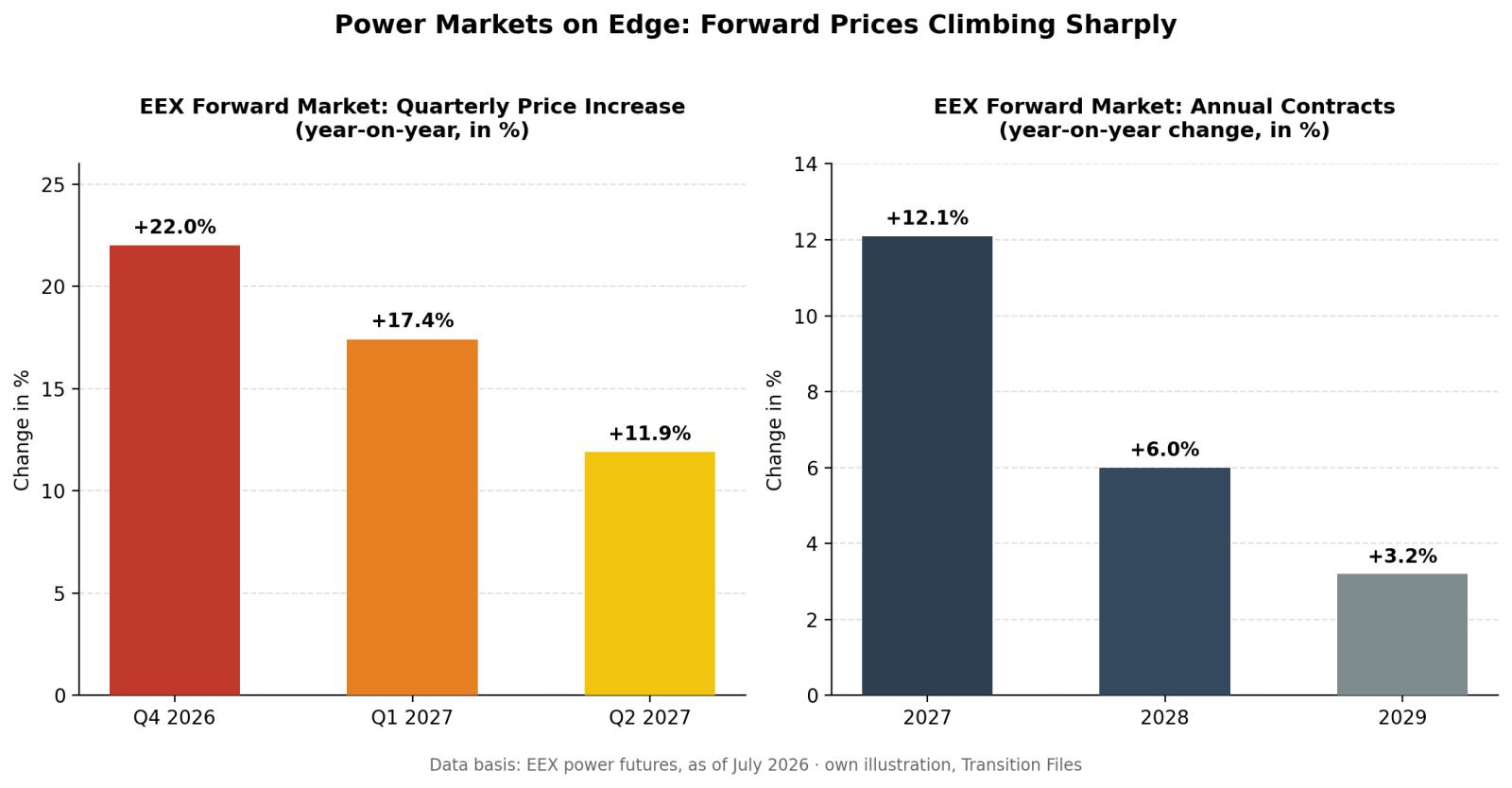
The numbers show a clear acceleration. Prices for the nearest delivery quarters are rising noticeably faster than contracts further out on the horizon: the fourth quarter of 2026 is trading around 22 percent above the same quarter a year earlier, the first quarter of 2027 around 17 percent higher, and the second quarter of 2027 still roughly 12 percent higher. The annual contracts show the same trend, though more muted: 2027 is up around 12 percent, 2028 around 6 percent, and 2029 only about 3 percent. In other words, the market is pricing in a considerably tighter environment mainly for the near future — expectations only ease again with some distance in time.
Three factors are driving this development:
First, fuel and CO₂ costs. Gas remains expensive given an uncertain LNG supply situation, and higher CO₂ prices are further increasing the cost of fossil-fuel power generation. Both feed directly into the exchange price.
Second, the so-called "Dunkelflaute" — a stretch of low wind and low sun. When wind and solar output collapse at the same time while demand stays high, spot-market prices can spike to a multiple of their usual level within a single hour. We've already seen this repeatedly over the past winters, with peak values well above 900 euros per megawatt-hour in individual hours. The more often such situations recur, the more they also shape expectations on the forward market.
Third, the structure of the power plant fleet. Notably, not all available capacity necessarily comes online during periods of scarcity — whether due to maintenance, economic considerations, or other reasons. That amplifies price spikes rather than cushioning them.
Why this matters to me as a logistics and energy professional
In the chemical industry and in energy-intensive logistics operations, electricity has long stopped being a minor cost item — it's become a strategic factor. Companies that source their power through dynamic tariffs or the spot market feel these price spikes immediately in their cost calculations. Those who instead procure early through the forward market buy themselves planning certainty — but now pay a noticeably higher price for it too, because the market has already priced in the risks.
To me, this once again shows how closely the energy transition, security of supply, and economic competitiveness are intertwined. Volatility isn't a temporary phenomenon that will simply resolve itself with the next expansion step in wind and solar — quite the opposite: the more weather-dependent generation enters the system, the more important flexible demand-management solutions, sufficient firm capacity for Dunkelflaute periods, and a market design that sets the right incentives even during scarcity become.
What this means for consumers and businesses
If your power contract is due to expire in the foreseeable future, it's worth taking a close look at current tariff offers — and weighing whether locking in a longer price guarantee now makes sense before forward prices climb further. For companies with high energy consumption, my view is this: a forward-looking, staggered procurement strategy protects better against price swings than hoping for a cheap day on the spot market.
The alarm bells on the power exchange are, in that sense, less a short-term disturbance and more a clear signal: the transformation of our energy system is far from complete — and the bill for it is currently being rewritten.
— Transition Files